There are details you notice immediately when buying socks.
The colour.
The pattern.
The material.
Maybe the price.
Then there are details you probably never see — yet they can completely change how the finished sock looks and feels.
Needle count is one of them.
Two pairs of socks can use similar cotton.
They can have the same basic shape.
They can even carry a remarkably similar design.
And yet one can feel noticeably smoother, look more refined and reproduce intricate artwork with much greater definition.
Why?
Sometimes the difference is hidden inside the machine that knitted them.
At Sock Republic, many of our signature fine-knit socks are produced using 200-needle circular knitting technology.
But what exactly does “200 needle” mean?
Does a higher needle count automatically make a better sock?
What’s the difference between 144, 168, 200 and even 240 needles?
And is 200-needle construction something you can actually feel — or just another technical number used in marketing?
Let’s get microscopic.
What Are 200 Needle Socks?
A 200 needle sock is knitted on a circular hosiery machine whose cylinder contains approximately 200 individual knitting needles positioned around its circumference.
That distinction is important.
It does not mean:
“200 needles per inch.”
And it is not the sock equivalent of a bedsheet’s thread count.
Instead, imagine looking down at the circular knitting cylinder from above.
Around that circle sit hundreds of extremely fine needles.
As the machine operates, those needles repeatedly form loops of yarn.
Those loops become the knitted fabric of the sock.
With a 200-needle machine, there are roughly 200 individual needle positions available around the cylinder.
More needle positions can mean more individual columns of stitches around the sock — giving the manufacturer the ability to work with finer yarns and create a more refined fabric and more detailed knitted artwork. This is also why hosiery manufacturers commonly use 200-needle machines for premium fine-gauge dress and jacquard socks. Fortis Green
Think of it as knitted resolution.
And that’s where things get interesting.

Needle Count Is Almost Like Resolution for a Knitted Design
Each needle position helps form part of the knitted design.
More needles around a similarly sized cylinder provide more individual stitch positions with which to build:
- Curves
- Diagonal lines
- Small motifs
- Letters
- Geometric patterns
- Colour transitions
- Repeating artwork
That is why fine 200-needle jacquard socks can reproduce detailed patterns considerably more cleanly than coarser constructions.
This becomes particularly important for Sock Republic’s Funky Socks collection, where the artwork is not simply printed onto the surface.
The design is knitted into the sock itself.
How Are 200 Needle Socks Different From Ordinary Socks?
You probably won’t count 200 tiny stitches while getting dressed in the morning.
What you may notice is what the needle count allows the manufacturer to create.

A Finer, Smoother Surface
Fine-gauge knitting can create a more refined fabric surface.
Instead of feeling coarse or unnecessarily bulky, a well-made 200N sock can feel remarkably smooth against the foot.
That makes this construction especially attractive for:
- Everyday crew socks
- Funky jacquard socks
- Dress socks
- Detailed patterned socks
- Smart-casual socks
- Premium corporate socks
It is one reason fine-gauge construction works particularly well in Sock Republic’s Dress Socks collection.
Inside a fitted formal shoe, refinement matters.
You usually don’t want an unnecessarily bulky sock competing for space.
Sharper Pattern Definition
This may be the easiest difference to see.
Fine diagonal lines look cleaner.
Curves look smoother.
Small patterns are easier to recognise.
Geometric shapes can have sharper edges.
Complex jacquard designs can appear considerably more sophisticated.
For a brand like Sock Republic, where socks are often visual products rather than plain basics, this matters enormously.
A beautiful illustration on a computer screen is irrelevant if the knitting machine cannot reproduce it convincingly.
168 Needle vs 200 Needle Socks: What’s the Difference?
This is probably the comparison most worth understanding.
A 168-needle machine has fewer needle positions around its cylinder than a comparable 200-needle machine.
That does not mean a 168N sock is automatically poor quality.
Far from it.
A good 168N sock can be an excellent sock.
The difference is largely about what kind of fabric and design you are trying to create.

168 Needle Construction
168N can work extremely well for:
- Everyday casual socks
- Simpler patterns
- Medium-weight constructions
- Designs that don’t require very fine detail
- Certain athletic constructions
200 Needle Construction
200N becomes particularly useful for:
- Fine-gauge dress socks
- Detailed jacquard
- Small geometric patterns
- Cleaner design edges
- Refined crew socks
- Premium lifestyle socks
Industry manufacturers similarly distinguish 168N as a versatile mid-range configuration and 200N as particularly well suited to finer fabric and complex jacquard work. Anemon Socks
So the question isn’t:
“Which number is bigger?”
It is:
“Which construction is right for the sock we are trying to make?”
144 vs 168 vs 200 Needle Socks
Let’s go one step further.
You’ll commonly encounter machines across several needle-count ranges.
| Needle Count | Broad Characteristics | Often Suitable For |
|---|---|---|
| 96–144 needles | Coarser gauge; accommodates thicker yarns and bulkier constructions | Heavy sports socks, cushioning, terry, bold/simple designs |
| 168 needles | Versatile mid-gauge construction | Everyday casual socks, simpler jacquard, medium-weight socks |
| 200 needles | Fine-gauge construction and greater pattern resolution | Premium crew socks, dress socks, intricate jacquard |
| 240 needles | Ultra-fine specialist construction | Luxury fine-gauge socks using exceptionally fine yarn |
This table needs one enormous asterisk:
Needle count is not a quality ranking.
A beautifully engineered 144-needle sports sock can be a vastly better product than a badly manufactured 200-needle sock.
Why?
Because needle count is only one ingredient.
The correct construction depends on the sock’s purpose.
Is a Higher Needle Count Always Better?
No.
And this is where many “premium sock” explanations go wrong.
It is tempting to say:
144 = good.
168 = better.
200 = premium.
240 = best.
Textile engineering isn’t that simple.
Imagine you’re creating a thick basketball sock with deep terry cushioning.
You may need:
- Heavier yarn
- Large terry loops
- Significant underfoot bulk
- Impact cushioning
An extremely fine machine may not necessarily be the ideal choice.
Conversely, if you are creating a sophisticated dress sock with a tiny houndstooth pattern, using an unnecessarily coarse machine would make very little sense.
The better rule is:
Higher needle counts enable finer construction. They do not automatically make every type of sock better.
This distinction is important enough that specialist hosiery manufacturers explicitly recommend different gauges for different products rather than treating needle count as a universal quality score. Anemon Socks
So Why Does Sock Republic Use 200 Needles?
Because of the kind of socks we’re trying to make.
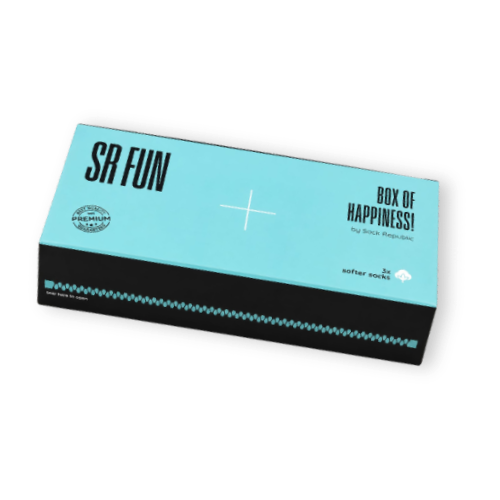
Sock Republic’s signature SR FUN socks are heavily design-driven.
They include:
- Detailed graphics
- Geometric artwork
- Repeating patterns
- Fine lines
- Multiple colours
- Illustrative motifs
We don’t want the design to simply be recognisable.
We want it to look clean.
That is where 200-needle fine jacquard construction becomes valuable.
The finer knitting allows the artwork to translate into yarn with significantly greater precision.
You can see this philosophy across our Funky Socks and Crew Socks collections.
Why 200 Needle Socks Can Look Less “Pixelated”
A knitted pattern is effectively built stitch by stitch.
That creates a limitation.
The machine cannot draw half a stitch.
Every curve, diagonal and letter must be translated into the available knitted grid.
With fewer stitch positions, diagonals may appear more stepped.
Curves can look blockier.
Small shapes can lose definition.
Increase the available resolution, and the machine gets more opportunities to describe those shapes.
This is particularly noticeable in:
Geometric Designs
Triangles, diamonds, zigzags and repeated geometry rely on clean edges.
Typography
Small letters can quickly become unreadable on coarser knitting.
Logos
Corporate logos often contain curved edges or very specific proportions.
Small Repeat Patterns
Houndstooth, micro-dots and intricate motifs benefit considerably from greater pattern resolution.
This is one reason 200N construction is also extremely useful when developing custom-branded socks in bulk.
When a client’s logo is being knitted into a product, detail matters.
Is 200 Needle the Same as 200 Gauge?
You’ll sometimes hear the phrases used loosely together.
Technically, it is better to talk about needle count.
“200 needle” generally refers to the number of needles installed around the knitting cylinder.
Gauge can involve the density or spacing of needles relative to the machine dimensions.
Because cylinder diameters and machine specifications vary, needle count alone doesn’t describe absolutely everything about the machine.
For consumer purposes, however, 200N or 200 needle is the common shorthand used to describe this fine-gauge hosiery construction.
Is Sock Needle Count the Same as Thread Count?
No.
This is another common misunderstanding.
Bedsheets are commonly marketed using thread count.
Socks are knitted rather than woven.
Needle count instead tells you something about the knitting machine used to form the sock.
So:
Bedsheet → thread count
Fine knitted sock → needle count / machine gauge
They are different textile measurements.
Both can relate indirectly to fabric refinement, but they should not be treated as equivalent numbers.
Does 200 Needle Mean the Sock Is Thicker?
No.
In fact, often the opposite.
Dense does not mean thick.
This is one of the most useful ways to understand premium fine-gauge knitting.
A 200N machine can use finer yarn and form a large number of smaller loops.
That can create fabric that is:
dense + fine + smooth
rather than:
dense + bulky + heavy.
This distinction matters especially with dress socks.
A well-engineered fine-gauge sock can feel substantial and refined while remaining slim enough to sit comfortably inside formal footwear.
That is why we would never judge sock quality simply by squeezing a pair and asking:
“How thick does it feel?”
More material is not automatically more sophistication.
Does 200 Needle Construction Make Socks Softer?
It can contribute to a smoother hand feel.
But there is an important qualification.
Needle count does not create softness by itself.
Softness also depends on:
- Fibre
- Yarn quality
- Yarn fineness
- Spinning
- Knit structure
- Finishing
- Washing
- Supporting fibres
Put low-quality yarn onto an expensive knitting machine and the machine does not magically turn it into exceptional yarn.
Premium sock construction is a system.
Good fibre + good yarn + appropriate machine + good knitting + good finishing.
Remove one of those pieces and the final product changes.
This is why our guide to why premium-quality socks are worth investing in goes far beyond needle count alone.
Does a 200 Needle Sock Last Longer?
Potentially — but again, needle count isn’t the only variable.
Fine, controlled construction can create a stable, refined fabric.
However, durability also depends on:
- Yarn strength
- Fibre length
- Reinforcement
- Heel construction
- Toe construction
- Abrasion
- Fit
- Washing
- Footwear
A poorly selected yarn can still wear prematurely.
A heel can still fail if it has not been engineered appropriately.
An incorrectly washed premium sock can still be damaged.
The more accurate statement is:
200-needle construction can contribute to a high-quality, durable sock when it is combined with appropriate yarn, reinforcement and finishing.
And one of the best tests isn’t what the sock looks like on day one.
It is how it looks later.
Our guide to what happens to socks after the first wash explains why wash behaviour can reveal quality that isn’t obvious when the product is new.
Can You Feel the Difference Between 168N and 200N?
Often, yes — particularly when comparing similarly designed socks made using appropriate yarns.
A 200N construction may feel:
- Finer
- Smoother
- Less coarse
- More refined
- Less bulky
But don’t conduct the comparison blindly without considering the yarn.
A plush 168N sock made from one material and a thin 200N sock made from another are not a controlled experiment.
The most meaningful comparison is:
similar yarn + similar style + different machine construction.
That lets the influence of needle count become much easier to appreciate.
Why Needle Count Matters So Much for Funky Socks
A plain black sock can hide a lot.
A colourful jacquard sock cannot.
Once you introduce:
A tiny astronaut.
An intricate geometric repeat.
A bicycle.
A detailed floral motif.
A houndstooth pattern.
Fine stripes.
Or a company logo.
…the knitting machine is suddenly being asked to draw.
Except its paintbrush is yarn.
This is precisely where fine-gauge knitting earns its place.
Sock Republic’s Funky Socks collection uses detailed knitted artwork as part of the identity of the product.
The closer the knitted result comes to the designer’s original idea, the more successful the construction.
Why Needle Count Matters for Dress Socks
Funky socks benefit from pattern resolution.
Dress socks benefit from refinement.
Inside formal shoes, you often want a sock that feels:
- Fine
- Smooth
- Elegant
- Low-bulk
- Secure
This is very different from the plush feel you might want in a winter or heavy sports sock.
Fine-gauge knitting therefore makes particular sense for premium Dress Socks.
Subtle patterns also benefit.
A micro-dot, pinstripe, small diamond or fine geometric design can look far more sophisticated when the knitted structure has enough resolution to render it cleanly.
What About 240 Needle Socks?
This is where Sock Republic’s story now goes beyond the original article.
200N is not the finest construction we use.
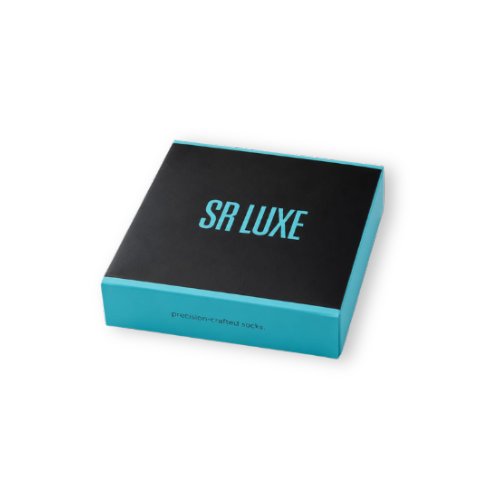
Selected socks within our SR LUXE range are crafted using 240-needle Italian-made Busi machines.
Why go even finer?
Because when you’re working with an exceptional material such as Egyptian Giza 45 cotton, an ultra-fine machine can create a correspondingly refined fabric.
The result is a different proposition from 200N funky socks.
200 needles may be superb for detailed premium jacquard.
240 needles can take fine-gauge luxury into an even more specialised territory.
Explore our Luxury Socks collection to see that approach.
The important wording here is Italian-made Busi machines.
The socks themselves are not “Italian-crafted.”
The Italian engineering is in the machinery.
200 Needle vs 240 Needle: Is 240 Automatically Better?
Still no.
We come back to the same principle.
A number needs context.
Imagine comparing:
A 200N colourful jacquard crew sock.
With:
A 240N Egyptian cotton luxury dress sock.
They have different jobs.
Different yarns.
Different designs.
Different wearing occasions.
Different manufacturing objectives.
240N provides an exceptionally fine platform for ultra-refined yarns and luxury constructions.
That doesn’t make every 200N product obsolete.
It simply gives the manufacturer another level of precision when the product calls for it.
Why Yarn Quality Still Matters More Than the Number on the Machine
Suppose you have the finest camera in the world.
Now put a poor-quality lens in front of it.
Your expensive camera cannot recover all the detail the lens failed to capture.
Sock manufacturing works similarly.
The machine is only one part of the equation.
A premium sock requires appropriate:
fibre → yarn → machine → knit structure → finishing
For cotton socks, this is why the quality of the cotton yarn matters.
Longer, cleaner, better-controlled fibres can create smoother yarn.
Smooth yarn combined with fine-gauge knitting can create an exceptionally refined textile surface.
That combination is much more meaningful than shouting:
“200 needles!”
without explaining what is being knitted on those needles.
Does 200 Needle Construction Reduce Pilling?
Needle count alone cannot guarantee a pill-free sock.
Pilling is influenced by:
- Fibre length
- Yarn hairiness
- Yarn twist
- Fabric construction
- Friction
- Washing
- Wear
However, a fine, controlled structure combined with quality yarn can contribute to a cleaner surface.
This is why a properly engineered premium sock should be assessed as an entire textile system rather than through one specification.
If you want to understand what fuzzing, linting and pilling reveal after laundering, our first-wash sock quality guide goes much deeper into the subject.
How Are 200 Needle Jacquard Socks Actually Made?
The process is fascinating.
A design doesn’t simply get “uploaded” to a sock.
Artwork first needs to be translated into a knitting format the machine can interpret.
Individual needle positions then help create the design through carefully controlled yarn changes.
That means the designer has to think differently.
Photography-style gradients may not translate naturally.
Tiny text may need simplification.
Curves have to work within the knitted grid.
Colours have to be converted into actual yarns.
The design you see on the finished sock is therefore the result of both:
graphic design + textile engineering.
If you’d like to see that process properly, read How Are Jacquard-Knit Socks Made?.
You can also go behind the scenes in our broader guide to the socks manufacturing process.
Why 200 Needle Construction Matters for Custom Socks
This becomes particularly relevant when businesses approach Sock Republic with:
A company logo.
A mascot.
A campaign graphic.
An event identity.
A repeating brand motif.
The client doesn’t want something vaguely similar to their artwork.
They want their artwork translated faithfully into knit.
More available stitch positions can help give the designer greater control over fine features.
That makes 200N fine jacquard especially valuable when producing premium custom socks where visual precision matters.
If you’re developing branded socks for a company, retail collection or corporate project, see our step-by-step guide to getting custom-branded socks made in bulk.
How Can You Tell If a Sock Is Really 200 Needle?
This is difficult to determine reliably just by looking at a product photo.
A genuinely transparent manufacturer or brand should be able to specify the machine construction.
But remember:
Even if the sock is genuinely made on a 200-needle machine, that number alone tells you nothing about:
- Fibre quality
- Yarn quality
- Reinforcement
- Elastic recovery
- Dyeing
- Finishing
- Toe comfort
- Overall manufacturing quality
Treat 200N as a meaningful technical specification.
Not a magic certification.
What Should You Look for When Buying 200 Needle Socks?
Needle count should be one part of your evaluation.
Look at the complete product.
Ask what fibre is being used.
Check whether the yarn is premium-grade.
Look at the clarity of the pattern.
Consider whether the sock is appropriate for your intended footwear.
Check the heel and toe construction.
Look at the material composition.
Check the washing instructions.
And ultimately ask the most important question:
Does the product still feel premium after repeated wear?
A specification matters only if it improves the experience.
Who Are 200 Needle Socks Best For?
200N socks make particular sense if you value:
- Fine, detailed patterns
- Smoother knitted surfaces
- Sophisticated dress socks
- Premium crew socks
- Low-bulk comfort
- Sharp jacquard artwork
- Refined everyday socks
If that sounds like your wardrobe, explore Sock Republic’s Funky Socks, Dress Socks and Crew Socks.
For even finer specialist constructions, the SR LUXE Luxury Socks collection moves into 240-needle territory on selected styles.
Frequently Asked Questions About 200 Needle Socks
What does 200 needle mean in socks?
It generally means the sock is knitted on a circular hosiery machine containing approximately 200 needles around its cylinder. Those needles form the knitted loops that create the sock.
Does 200 needle mean 200 needles per inch?
No. This is a common misconception. It refers to the machine’s needle count around the cylinder, not 200 needles per inch of fabric. Fortis Green
Are 200 needle socks better?
For fine-gauge, detailed and lightweight premium constructions, 200N can offer significant advantages. However, it is not automatically superior for every type of sock.
What is the difference between 168 and 200 needle socks?
A 200N machine has more needle positions around a comparable cylinder, enabling finer yarns, more stitch columns and greater potential pattern resolution. 168N remains highly suitable for many everyday and medium-gauge constructions.
What is the difference between 144, 168 and 200 needle socks?
Broadly, lower needle counts are suited to coarser yarns and heavier constructions, while increasing needle count allows finer fabrics and greater pattern detail. The ideal count depends on the sock’s purpose.
Are 200 needle socks thinner?
They can be finer and less bulky because the construction can use thinner yarn and smaller knitted loops. But actual thickness still depends on yarn and knit structure.
Are 200 needle socks denser?
With comparable machine dimensions and appropriate yarn, the greater number of needles provides more knitted stitch columns around the sock and can create a fine, closely controlled construction.
Are 200 needle socks more comfortable?
They can feel smoother and more refined, particularly in dress and lifestyle applications. Comfort also depends on fibre, fit, seams, elastane and finishing.
Do 200 needle socks last longer?
Needle count can contribute to a stable fine-knit fabric, but durability depends heavily on yarn quality, reinforcement, construction, care and how the socks are worn.
Do 200 needle socks pill less?
Needle count alone cannot guarantee this. Pilling is also affected by fibre quality, yarn hairiness, friction, knit structure and laundering.
Are 200 needle socks good for dress shoes?
Yes. Fine-gauge, low-bulk 200N construction is particularly well suited to many dress-sock applications.
Are 200 needle socks good for funky patterns?
Yes. The additional stitch positions can allow detailed jacquard artwork, curves, geometric designs and small motifs to be rendered with greater precision.
Are 200 needle socks good for sports?
They can be used in some athletic constructions, but a higher needle count is not automatically ideal. Heavily cushioned sports socks may deliberately use lower-gauge machines and thicker yarns.
What are 240 needle socks?
240N socks use an even finer knitting configuration. Sock Republic uses 240-needle Italian-made Busi machinery for selected ultra-luxury Egyptian Giza 45 cotton socks.
Is 240 needle better than 200 needle?
It is finer, but not universally “better.” The correct needle count depends on material, sock style, desired thickness, artwork and end use.
Is needle count the same as thread count?
No. Thread count is primarily associated with woven textiles. Sock needle count refers to the knitting-machine configuration.
The Bottom Line: 200 Needles Aren’t a Marketing Number — They’re a Manufacturing Choice
The best technical details are the ones you eventually stop noticing.
You don’t put on a pair of socks and think:
“Ah yes, approximately 200 needles were involved here.”
You notice something else.
The pattern looks unusually sharp.
The fabric feels smooth.
The sock doesn’t feel unnecessarily bulky.
The little geometric details actually look like the artwork.
The pair simply feels more refined.
And behind that experience may be a machine doing something incredibly precise:
forming thousands upon thousands of loops, using hundreds of tiny needles, turning individual strands of yarn into a finished sock.
That is why needle count matters.
But it is also why needle count should never be viewed in isolation.
200 needles cannot rescue poor yarn.
240 needles cannot fix bad design.
And a lower-gauge machine can be exactly the right choice when the product needs thickness, cushioning or a different structure.
Premium sock making is about choosing the right yarn, the right machine and the right construction for the job.
For Sock Republic’s detailed jacquard and fine everyday styles, 200-needle knitting gives us precisely the combination we’re looking for:
refinement, detail and a beautifully fine knit.
Explore Sock Republic’s Funky Socks and Dress Socks to experience 200-needle fine-gauge construction, or step into SR LUXE to discover how far fine knitting can go with selected 240-needle constructions.
Because with great socks, sometimes the difference really is in the details you cannot see.