

A custom sock looks simple when it is finished.
Your logo. Your colours. Your design. Your packaging.
Done.
Except the finished pair hides dozens of decisions that were made before a single sock reached the knitting machine.
What yarn should you use?
Should the sock be crew, ankle or no-show?
Will the artwork actually translate into knitted stitches?
How many colours can the design handle?
What does “200-needle” really mean?
Do you need a physical sample?
How many pairs do you need to order?
And perhaps most importantly:
How do you make sure the 1,000th pair looks as good as the first?
Whether you are creating custom socks for corporate gifting, employee merchandise, an event, a D2C fashion label, a sports team, a promotional campaign or private-label retail, the process becomes much easier when you understand how custom sock manufacturing actually works.
This guide takes you through the entire journey — from the first idea to the final cartons.
And unlike a generic merchandise guide, this is written from the perspective of people who actually make socks.
The process can be broken into seven core stages:
It sounds straightforward.
The quality of the finished product, however, depends on how well each of those stages is handled.
If you’re actively sourcing a manufacturer, you can also explore Sock Republic’s Custom Socks & Bulk Manufacturing service.
Before discussing yarn, colours or logo placement, answer one question:
Because a sock designed for an employee welcome kit should not necessarily be engineered like one intended for a premium fashion label.
The purpose determines almost everything that follows.
Corporate socks usually need to balance:
Subtle logo placement often works better than turning the entire sock into an advertisement.
The goal should be:
“I would actually wear these.”
Not:
“This looks like company merchandise.”
For more inspiration, see our guide to 7 scenarios where custom socks can make a difference.
Retail socks have a different job.
They need to survive customer scrutiny.
That means paying much greater attention to:
If the socks are going to carry your brand name, they are effectively a textile product bearing your reputation.
Events often involve larger quantities and fixed deadlines.
Here, the priorities may shift toward:
Performance socks require completely different engineering.
Cushioning, mesh ventilation, arch support, compression zones, heel reinforcement and moisture behaviour may become more important than decorative complexity.
The first step, therefore, is not designing the sock.
It is defining the job the sock needs to do.
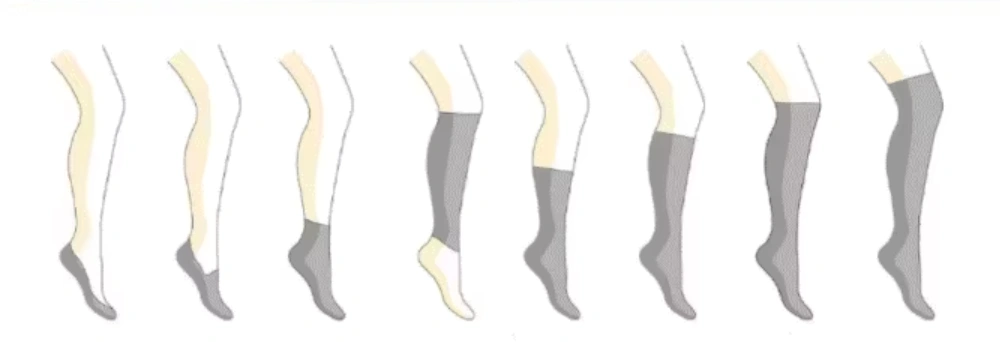
Once the purpose is clear, choose the basic silhouette.
Crew socks are usually the most versatile choice for custom branding.
The larger leg area gives designers more space for:
Crew length is particularly effective for corporate gifting, merchandise and fashion collections.
Ankle socks offer a sportier, more casual profile.
They work well for:
The available artwork space is smaller than a crew sock, so the design needs to be more disciplined.
No-show socks prioritise function over visible branding.
Branding might therefore appear:
These can be particularly useful for footwear and lifestyle brands.
Football, basketball, training and athletic socks can include more technical construction such as:
Never choose sock length purely because you like how it looks.
Choose it based on how the customer will actually use it.
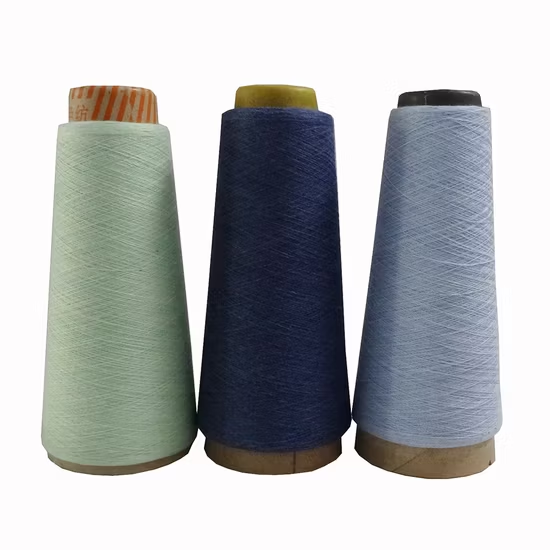
One of the most common mistakes in custom sock sourcing is focusing entirely on artwork.
The material will influence comfort long after someone stops admiring the logo.
For versatile custom socks, premium combed cotton remains an excellent option.
It offers:
Higher-grade, long-staple cotton yarns can also provide a smoother, more refined finished fabric.
Bamboo-rich yarn is often chosen when the product is positioned around softness and premium comfort.
It can work particularly well for:
For athletic socks, synthetic performance fibres may be appropriate because they can contribute:
Even a cotton-rich sock usually contains small amounts of supporting fibres.
Elastane helps provide stretch and recovery.
Polyamide or nylon can improve durability.
A good blend is not necessarily a compromise.
It is often what makes the sock perform properly.
Needle count is one of the most misunderstood aspects of sock manufacturing.
A knitting machine forms the sock through loops created around a cylinder.
Broadly speaking, a higher needle count allows the manufacturer to work with finer yarn and achieve a denser, more refined knit.
Sock Republic specialises in premium 200-needle fine jacquard-knit socks.
Compared with coarser knitting, fine-gauge construction can produce:
It is particularly useful when a brand wants its custom socks to feel like an actual premium fashion product rather than promotional merchandise.
You can read the complete explanation in our guide to 200-needle socks and fine-gauge knitting.
For certain luxury applications, knitting can go even finer.
But more needles do not automatically mean a better product.
The machine, yarn, design, tension and finishing all need to work together.
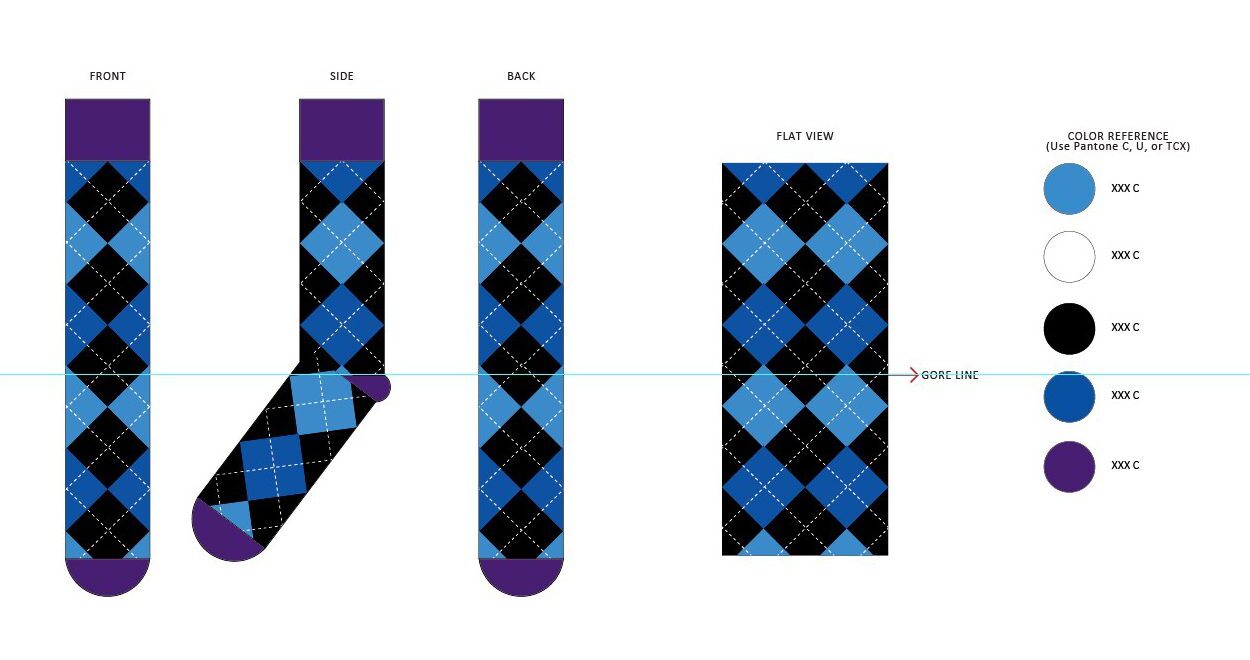
This is where custom sock manufacturing differs dramatically from printing a T-shirt.
With premium jacquard socks, the design is knitted into the fabric itself.
The machine needs instructions telling individual needles when to knit different yarn colours.
That means your logo or artwork has to be translated into a machine-readable knitting design.
At Sock Republic, our designer prepares a digitised BMP design file specifically for the knitting machine.
This is much closer to programming the design stitch by stitch than applying an image onto finished fabric.
A logo that looks perfect on a 4K monitor may not translate perfectly into knitted loops.
Very fine details can disappear.
Tiny letters may become difficult to read.
Complex gradients generally do not behave like printed artwork.
The designer therefore needs to interpret the brand identity intelligently.
The objective isn’t simply:
“Copy the image.”
It is:
“Make this image look excellent when knitted.”
Ideally provide:
If you only have a JPEG logo or rough idea, a capable custom socks manufacturer should still be able to guide you through the process.
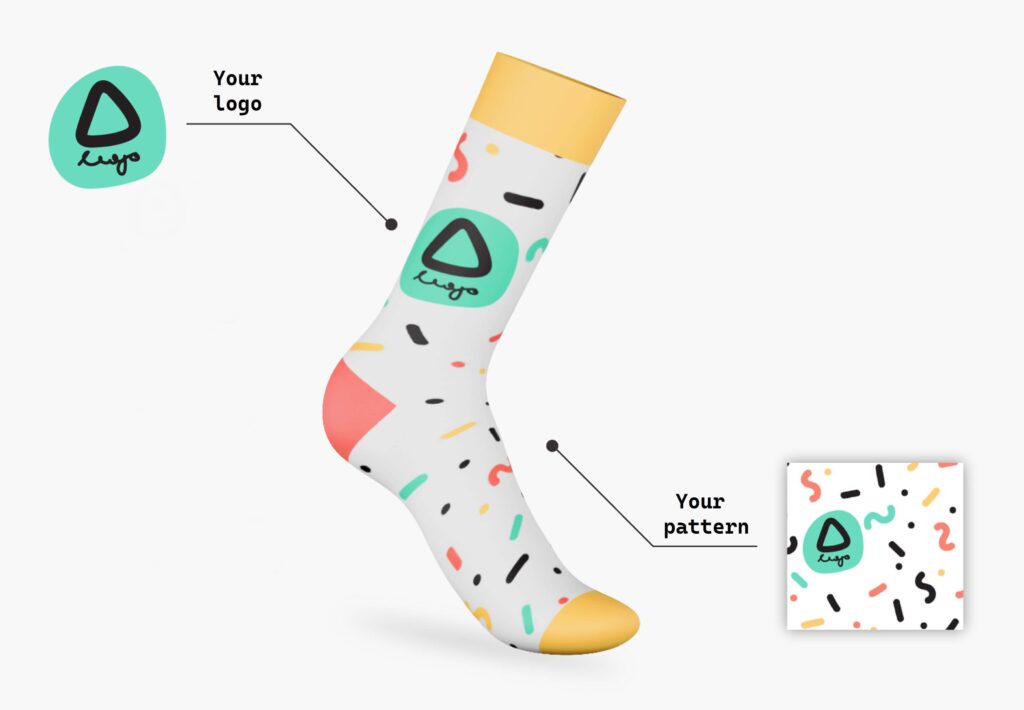
Good custom socks do not need to scream the company name.
Some of the most wearable branded socks use branding intelligently.
A logo can appear:
Instead of repeating a logo endlessly, you can convert the brand’s visual language into a pattern.
Think:
This usually produces socks people are more likely to wear outside the event or office.
Brand Pantones are useful, but sock colours depend on yarn availability and the behaviour of knitted yarn.
A physical sample is therefore much more reliable than judging colour entirely from a screen.
This is perhaps the most important step in the entire process.
Never approve a serious custom sock order based solely on a digital design.
A screen cannot tell you:
That is why Sock Republic uses mandatory sample proofing before moving into bulk production.
Look carefully at:
Put the sample on a foot.
Stretch it.
Look at it from a distance.
Wash it if your project requires additional durability evaluation.
A custom sock is a three-dimensional stretch textile.
Judge it that way.
MOQ means Minimum Order Quantity.
And this is where many projects become unnecessarily expensive.
At Sock Republic, the standard MOQ for fully customised socks is generally 500 pairs per design, subject to the particular construction and yarn requirement.
Why does MOQ exist?
Because producing a custom sock requires:
The same setup effort cannot economically be spread across an extremely small number of pairs.
Suppose you want 500 pairs.
One design in one colour is considerably easier to produce efficiently than splitting the same quantity across multiple colours.
A 250/250 split may therefore increase your per-pair cost.
If budget efficiency matters, simplify your first production run.
Fewer variations usually mean:
There is no meaningful universal price for custom socks.
The final cost depends on what you ask the manufacturer to build.
Premium combed cotton costs more than low-grade commodity yarn.
Speciality fibres such as bamboo or luxury cottons may increase costs further.
A crew sock uses more yarn than an ankle or no-show sock.
Fine-gauge knitting can require finer yarn, specialised machinery and slower production.
More colours may increase yarn management and production complexity.
Terry cushioning uses more yarn and can change production time.
Larger quantities spread setup costs across more units.
A simple sock tag costs very differently from a fully printed presentation box.
The right way to reduce cost is therefore not automatically to ask:
“Can you make the sock cheaper?”
Ask:
“Which part of the specification can we simplify without damaging the customer experience?”
That is a much better manufacturing conversation.
Custom socks may be the product.
Packaging is often the first thing the recipient sees.
Tags are practical for:
They can include your:
Printed sleeves provide more surface area without the cost of a full presentation box.
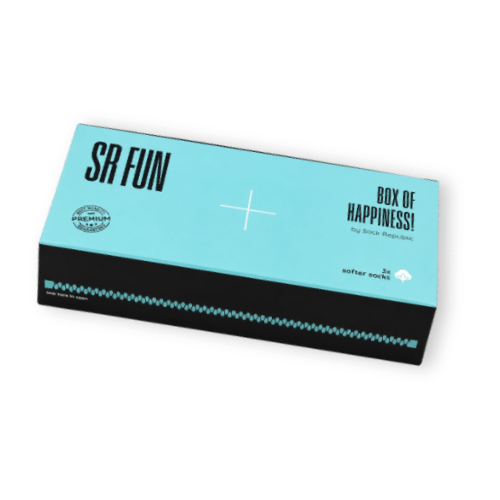
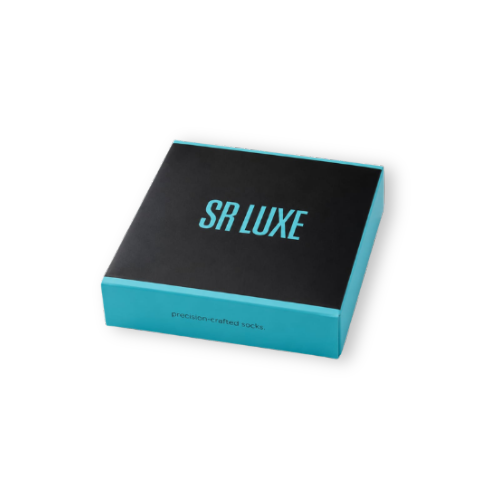
For premium corporate gifting, custom boxes can transform socks into a genuine gift product.
Single-pair, double-pair and triple-pair box formats can all be developed depending on your project.
Custom packaging has its own MOQ and production timeline, so do not leave this decision until the socks are already finished.
Sock Republic’s current corrugated custom-box projects typically require larger packaging MOQs than the socks themselves, and box production may need several weeks.
Plan the two production streams together.
Once the sample is approved, the approved sample becomes the benchmark.
Bulk manufacturing typically follows a sequence such as:
Required yarns are allocated according to the approved design.
The digitised design is loaded and the knitting setup is checked.
The sock body is produced on circular sock-knitting machines.
The open toe is closed and finished.
The socks are processed to achieve the required appearance and hand feel.
Where appropriate, socks are shaped to create a consistent finished form.
Pairs are checked for visible knitting or construction defects.
Approved pairs are matched, tagged and prepared for shipment.
For a deeper look inside the factory, see our complete guide to the socks manufacturing process.
Making 1,000 socks is one challenge.
Making the 1,000th sock look like the first is the real one.
Quality control should examine:
For premium projects, wash behaviour may also need consideration.
The sample you approve should remain the visual and construction reference for bulk production.
This is especially important for private-label brands because your customer does not know who manufactured the sock.
They only see your name on it.
Do not ask:
“How fast can these be made?”
Start with:
“When must the finished order be in my hands?”
Then work backwards.
Your timeline may include:
For straightforward orders of up to roughly 1,500 pairs, Sock Republic can typically manufacture within approximately 10–15 days after final approval, depending on the design, yarn availability and production schedule.
Larger or more complex orders may need longer.
Custom printed boxes can have significantly longer lead times, so packaging should be initiated early.
If you have a fixed event date, tell the manufacturer on day one.
Never reveal the deadline after the sample has already been approved.
Once production is finished, the socks need to reach you safely and on time.
Courier or surface logistics are generally straightforward, with the final method depending on:
For export projects, consider:
If you are an international brand considering Indian manufacturing, our guide to why India is an ideal destination for private-label sock manufacturing goes deeper into the sourcing side.
The easiest custom sock order should be the second one.
Once your design has been approved and successfully manufactured, keep a record of:
That creates a production reference for future runs.
Reorders can then move much faster because the product does not need to be reinvented.
The manufacturing process may be similar, but the commercial objective is different.
Usually intended for:
Brand communication is the priority.
Usually intended for retail under another brand’s name.
These projects often require greater attention to:
If you plan to sell socks rather than simply gift them, treat the project like product development — because that is exactly what it is.
Decide who will wear the socks first.
Then design them.
Remember: yarn is not ink.
Design for knitting.
Never do this on a serious bulk order.
Too many colours and sizes can destroy production efficiency.
A small saving per pair becomes irrelevant if the finished product damages your brand.
Packaging can have a longer lead time than the socks themselves.
Perhaps the biggest mistake of all.
The best branded sock is still a great sock first.
Look beyond the quotation.
Ask questions.
Request samples of their actual work.
Machine capability determines what designs and constructions can realistically be produced.
A premium knit manufacturer should understand how artwork translates into stitches.
A manufacturer unwilling to produce a proper sample should make you cautious.
End-to-end support reduces coordination headaches.
Manufacturing problems become much easier to solve when communication is fast and precise.
A promotional giveaway and a luxury D2C sock are not the same product.
Your manufacturer should know the difference.
Sock Republic approaches custom socks from the perspective of a premium sock brand first and a manufacturer second.
That distinction matters.
We understand what the end customer actually notices:
The hand feel.
The knit.
The fit.
The colour.
The toe.
The packaging.
And what the sock looks like after it has actually been worn.
Our custom capabilities cover:
If you’re ready to turn your design into a physical sample, visit our Custom Socks Manufacturing & Bulk Enquiry page.
At Sock Republic, the standard MOQ for most fully customised designs is 500 pairs per design, although construction, yarn and colour requirements can affect the final MOQ and costing.
It may be possible, but splitting the production quantity across colours generally increases production complexity and can increase the cost per pair.
Yes. You can provide a finished design, your logo and brand colours, or simply a concept. The artwork is then adapted for knitted production.
A visual concept can help communicate the idea, but jacquard-knit production ultimately requires a machine-level digitised design file rather than simply a conventional product mockup.
The final production design is digitised into a machine-readable BMP-style knitting file based on the machine specification.
Yes. A physical sample should be approved before moving into serious bulk production.
Simple orders can often be produced within a few weeks after sample approval. At Sock Republic, quantities up to approximately 1,500 pairs may typically require around 10–15 days of production, depending on yarn availability, complexity and factory scheduling.
Yes. Logos can be knitted horizontally, vertically, repeatedly, discreetly or incorporated into an all-over design.
Yes. Custom socks can be produced with company branding, tags and optional gift packaging for employee gifting, clients, events and promotional campaigns.
Yes. A manufacturer can develop custom products, branding and packaging for retail under your own label.
Yes. Options can include branded tags, sleeves, individual packaging and custom boxes.
Yes, although custom boxes normally carry their own MOQ and production timeline.
Yes. Sock Republic specialises in premium custom sock construction, including fine-gauge jacquard knitting and premium yarn options.
Yes. International orders can be shipped subject to freight, documentation, destination duties and taxes.
Custom socks do not have to be complicated.
The process becomes complicated when the early decisions are vague.
Know what the socks are for.
Choose the right construction.
Design for knitting rather than printing.
Approve the physical sample.
Keep the number of variations sensible.
Plan packaging early.
And choose a manufacturer who understands that the final pair is carrying your brand, not theirs.
Because the goal is not simply to manufacture socks with your logo.
It is to create something people actually want to put on their feet.
And when someone chooses to wear your branded socks again — long after the event, gift or campaign is over — that is when custom merchandise stops being merchandise.
It becomes part of their wardrobe.
Ready to start your project?
connect@sockrepublic.in
7827719755 (WhatsApp chat)