You trained for the sled.
You practised wall balls until your shoulders stopped negotiating.
You’ve run kilometre repeats on tired legs, learned to love the SkiErg—or at least hate it slightly less—and probably spent an unreasonable amount of time deciding which shoes will make it to race day.
And then you reach into your drawer and grab…
the same socks you wear to the gym.
That tiny decision could matter more than you think.
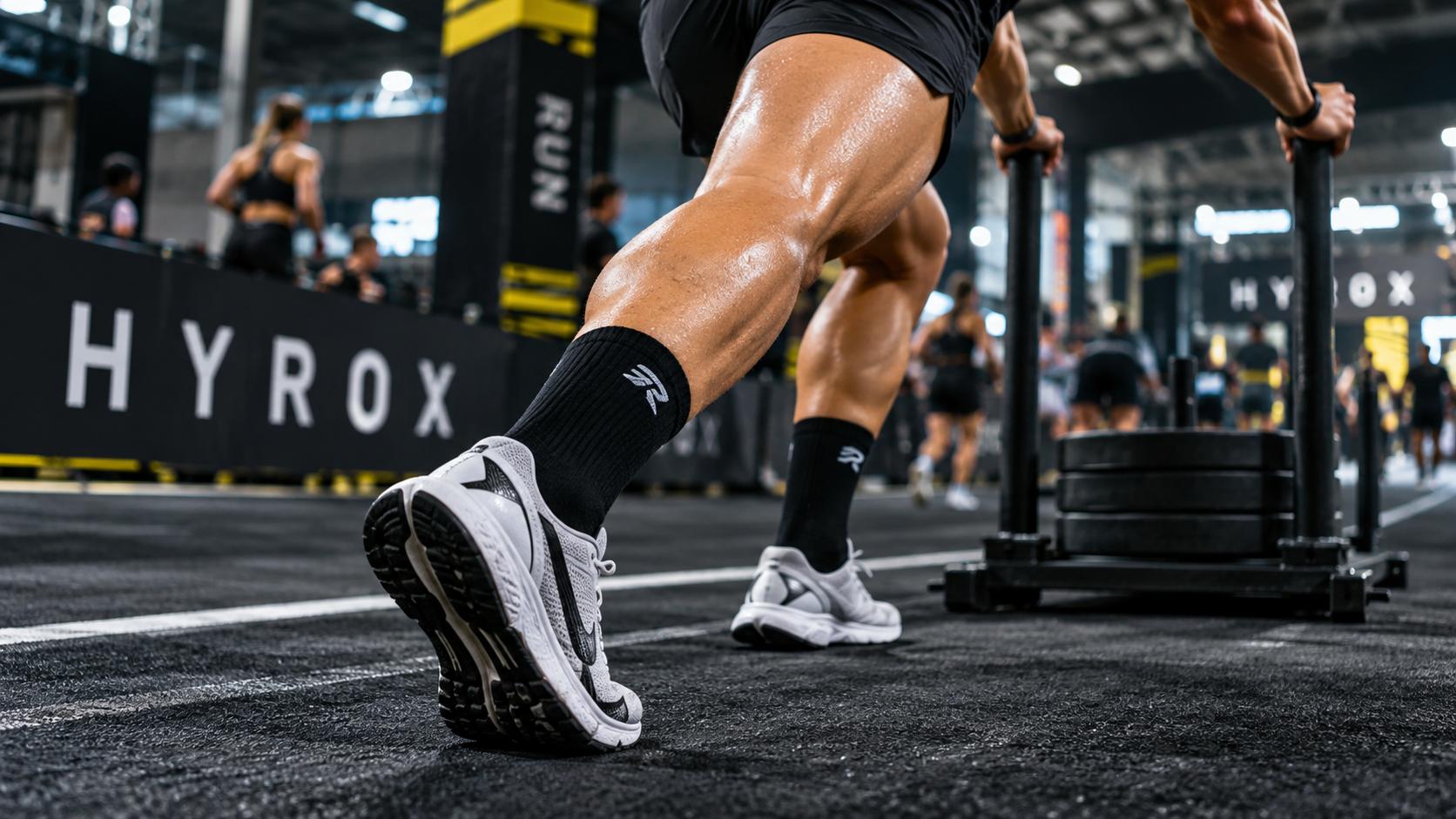
Because HYROX isn’t quite running. It isn’t quite strength training. And it definitely isn’t an ordinary hour at the gym.
It asks your feet to run, stop, push, pull, jump, lunge, carry and then somehow start running again.
For kilometres.
So while shoes understandably get most of the attention, there’s another piece of equipment sitting directly between those shoes and your feet for the entire race.
Your socks.
Welcome to the surprisingly serious world of HYROX socks.
First Things First: What Exactly Is HYROX?
If HYROX seems to have suddenly appeared everywhere—from your gym to your Instagram feed—you’re not imagining it.
HYROX is a standardised indoor fitness race combining eight 1 km runs with eight functional workout stations.
The sequence looks like this:
1 km Run → 1,000 m SkiErg
1 km Run → 50 m Sled Push
1 km Run → 50 m Sled Pull
1 km Run → 80 m Burpee Broad Jumps
1 km Run → 1,000 m Row
1 km Run → 200 m Farmers Carry
1 km Run → 100 m Sandbag Lunges
1 km Run → 100 Wall Balls
Eight kilometres of running.
Eight workout stations.
One increasingly questionable relationship with your quadriceps.
Unlike an ordinary gym session, however, you’re not completely recovering between exercises. The format repeatedly sends you back onto the run course after demanding functional movements.
HYROX itself points out that half of the race is running, with competitors typically spending considerable time on their feet.
And that changes what you should expect from your socks.
Why Are Socks So Important for HYROX?
Think about what happens inside your shoes during the race.
You’re running forwards.
Then driving aggressively through your feet during a sled push.
Then potentially moving backwards while pulling.
Then running again.
Then jumping.
Then running.
Then carrying.
Then lunging.
Then—because apparently your legs haven’t filed enough complaints—running some more.
Each transition changes the forces between your foot, sock and shoe.
Your sock isn’t simply covering your foot.
It is part of the interface between your body and your footwear.
A poor sock choice can potentially mean bunching, excessive moisture, unwanted movement or friction exactly when you’d rather be thinking about your next station.
That’s why the best socks for HYROX aren’t necessarily the thickest, most cushioned or most expensive pair you can find.
They’re the pair that can handle the hybrid nature of the event.
Regular Gym Socks vs HYROX Socks: What’s the Difference?
There isn’t an official category of sock you are required to wear for HYROX.
And you certainly don’t need a sock with the word HYROX printed on it.
What matters is construction.
An ordinary gym sock might work perfectly well for a strength session where you’re lifting, resting and moving around relatively little.
HYROX asks more of it.
A suitable performance sock needs to cope with:
- 8 km of accumulated running
- Repeated acceleration and deceleration
- Sweat over an extended effort
- High-friction movement inside the shoe
- Sled pushes and pulls
- Burpee broad jumps
- Loaded lunges
- Changes between running and functional stations
So rather than asking:
“Are these HYROX socks?”
ask:
“Are these socks built for what HYROX actually demands?”
That’s a much better buying question.
7 Things to Look for in the Best Socks for HYROX
1. A Secure Fit That Doesn’t Move With Every Station
This should be priority number one.
A performance sock should fit close to the foot without constantly shifting, twisting or bunching.
That’s important during running, but HYROX adds another challenge.
Imagine the transition from running into a heavy sled push.
Your body angle changes. You’re generating force through your legs and feet. Then you’re back upright and running again.
You don’t want the sock sliding around independently inside the shoe.
Look for a construction that follows the shape of the foot and provides a secure heel fit.
Some performance socks—including Sock Republic’s PREDATRS Athletic Performance Socks—use dedicated left and right anatomical construction, allowing each sock to follow the respective foot more precisely.
For performance footwear, small fit details can make a surprisingly large difference.
2. Strategic Cushioning—Not Just More Padding
It’s tempting to think:
more cushioning = better performance sock.
Not necessarily.
Excessive padding can change how a shoe fits and make the foot feel warmer or less connected to the footwear.
Too little cushioning, on the other hand, may leave you wanting more comfort as the race progresses.
The smarter approach is strategic cushioning.
Terry-loop cushioning under high-contact areas of the foot can provide additional softness without requiring the entire sock to become bulky.
For HYROX, that’s particularly relevant because you’re combining running impact with force-heavy movements.
The goal isn’t to turn your foot into a pillow.
It’s to put cushioning where it actually earns its place.
You can learn more about performance-focused constructions in Sock Republic’s Performance Socks collection.
3. Moisture Management Matters
HYROX races take place indoors.
That doesn’t mean your feet stay cool.
You’re working continuously through running and functional stations, and moisture accumulating inside a shoe can affect comfort as the race progresses.
That’s why material choice and ventilation matter.
A good performance sock should help manage moisture rather than simply becoming saturated and remaining that way.
Breathable knit zones can also help airflow around parts of the foot that don’t require heavy cushioning.
The ideal HYROX sock isn’t just designed for impact.
It needs to handle heat as well.
4. Arch Support Can Help the Sock Feel More Secure
You’ll often see performance socks advertising an arch band or arch support.
It’s worth understanding what that actually means.
A knitted compression band around the midfoot isn’t magically going to make you run faster or replace a properly fitting shoe.
What it can do is help the sock hug the foot more securely and reduce unnecessary fabric movement.
That matters when you’re repeatedly changing between running and functional movements.
Think secure fit, not miracle performance technology.
That’s a much more useful reason to look for it.
5. Pay Attention to the Toe
Eight kilometres is enough time for an irritating toe seam to become very irritating indeed.
Add repeated lunges, jumps and loaded movements and your toes experience plenty of interaction with the front of your shoe.
Look for a smooth toe construction that minimises unnecessary bulk.
And make sure your shoes have sufficient room for your chosen sock.
A beautifully cushioned sock that makes an already-tight shoe even tighter isn’t an upgrade.
Sock and shoe need to work as a system.
6. Don’t Ignore the Heel
The heel is another area where fit matters.
A well-shaped heel pocket helps the sock sit where it should rather than creeping, twisting or creating excess material.
This is especially important if you’ve ever experienced socks gradually disappearing underneath your heel during training.
Race day isn’t the moment you want to discover that problem.
Your socks should become something you stop thinking about approximately thirty seconds after putting them on.
That’s the goal.
7. Choose the Right Sock Height
Crew?
Quarter?
Ankle?
There isn’t one mandatory height for HYROX.
Choose based on your footwear, personal preference and the construction that stays most securely in place.
A slightly higher performance sock can offer more coverage around the ankle and reduce the possibility of the cuff disappearing into the shoe.
Lower cuts may feel lighter and suit athletes who prefer minimal coverage.
What matters most is that the sock stays put throughout running and stations.
Race-day aesthetics come second.
Although, admittedly, looking good while questioning every life decision during the sled push doesn’t hurt.
Do You Need Grip Socks for HYROX?
This is becoming an interesting question as HYROX grows.
Grip socks use silicone or rubberised elements—usually underneath the foot—to reduce movement between the sock and the shoe.
The concept makes intuitive sense for movements requiring stability.
But there’s an important distinction:
shoe-to-floor grip and foot-to-shoe grip aren’t the same thing.
Your outsole determines how your shoe interacts with the race surface. HYROX itself specifically advises athletes to use grippy shoes for the sled push.
Grip elements inside the shoe address a different interface: movement between your foot, sock and shoe.
Some athletes like that locked-in sensation.
Others prefer a conventional performance sock.
So don’t assume a grip sock is automatically the best HYROX sock simply because it has silicone underneath.
Fit, moisture management, cushioning, shoe compatibility and comfort still matter.
Should You Wear Compression Socks for HYROX?
Compression is another area where marketing can get ahead of reality.
Some athletes enjoy the snug sensation of compression during endurance events. Others prefer conventional performance socks during competition and use compression garments around training or recovery.
If you’re considering compression, the most important rule is simple:
don’t experiment on race day.
Train in them first.
See how they interact with your shoes.
Make sure you genuinely find them comfortable over sustained efforts.
Sock Republic’s XELERATRS Graduated Compression Socks use graduated compression construction and represent a very different type of product from conventional athletic socks.
Neither category is automatically “better” for HYROX.
They serve different purposes and preferences.
If you’re choosing specifically for racing, prioritise what you’ve already tested successfully during HYROX-style sessions.
Can You Wear Cotton Socks for HYROX?
You can wear almost any comfortable sock that works for you.
But material becomes increasingly relevant as effort duration, heat and perspiration increase.
Traditional everyday cotton-rich socks are designed primarily around everyday comfort.
Dedicated performance socks can instead combine fibres and knitting structures to prioritise characteristics such as:
moisture management, ventilation, stretch, recovery, cushioning and secure fit.
That’s why your favourite casual socks aren’t automatically your best race socks.
Save the beautifully patterned funky pair for the post-race celebration.
Unless, of course, you’ve trained in them and they’re secretly unbeatable.
In which case, we respect the commitment.
HYROX Socks vs Running Socks: Are They the Same?
There’s considerable overlap.
After all, HYROX includes 8 km of running.
A good running sock already prioritises many useful characteristics:
- Secure fit
- Moisture management
- Breathability
- Cushioning
- Low-friction construction
- Shape retention
But HYROX introduces functional movements between those running segments.
That’s the difference.
A road-running sock primarily needs to perform through repetitive forward movement.
A HYROX athlete repeatedly transitions between running and exercises such as sled pushes, sled pulls, broad jumps, carries and lunges.
So the best running socks may also make excellent HYROX socks—but you should test them under hybrid training conditions, not just on a comfortable 5K.
For a deeper look at the running side of the equation, read our guide to running socks and performance sock construction.
What About Blisters?
Search for the best socks for HYROX and you’ll inevitably encounter the phrase anti-blister socks.
It’s worth being careful with that claim.
Blisters can be influenced by several interacting factors, including friction, moisture, footwear fit and individual biomechanics.
No sock can guarantee you’ll never develop one.
But your sock choice can affect the environment inside the shoe.
A sock that fits securely, manages moisture effectively and avoids bunching or irritating seams may help reduce some of the conditions associated with friction.
Your footwear matters too.
And perhaps most importantly:
don’t race in an untested sock-and-shoe combination.
Your longest or hardest training sessions are where your race kit earns its audition.
The Golden Rule: Nothing New on Race Day
This deserves its own section because athletes continue to ignore it.
Race expo has a shiny new pair of socks?
Don’t wear them for the first time tomorrow.
Bought expensive performance socks three days before HYROX?
Test them.
New compression socks that promise extraordinary things?
Train in them.
Changed shoes?
Definitely test them.
Your race-day sock should be boringly familiar.
You should already know:
how it feels after an hour,
whether the heel moves,
whether the toe irritates you,
whether the cushioning works with your shoes,
whether it gets uncomfortably warm,
and whether you’re still thinking about it halfway through training.
The best race equipment is often the equipment you’ve almost forgotten you’re wearing.
Your HYROX Race-Day Footwear Checklist
Before you head to the start line, ask yourself:
Have I trained in these exact socks?
Have I used them with these exact shoes?
Do they stay securely on my foot?
Is there enough room in my shoes with this level of cushioning?
Do my feet remain reasonably comfortable when sweaty?
Are there any seams or pressure points that annoy me?
Have I tested them while running after sled work, lunges or burpees?
If you can answer yes to all seven, you’ve probably made a better decision than simply buying whatever says “HYROX” on the packaging.
HYROX Is Coming to Gujarat—and Then Noida
If you’re reading this while training in India, the timing couldn’t be better.
After sold-out HYROX events in Delhi and Mumbai, the competition heads to Gujarat for the first time from 26–28 November 2026. HYROX then moves to Noida from 15–17 January 2027, with Open, Pro, Doubles and Relay formats available.
HYROX is clearly moving beyond being another international fitness trend imported into India.
It is becoming something people are specifically training for.
And that’s an important distinction.
Once your gym session becomes a race, equipment choices that once seemed insignificant start becoming worth thinking about.
Including what’s on your feet.
So, What Are the Best Socks for HYROX?
There isn’t one universally perfect pair.
Your feet, shoes, race division and preferences are different from somebody else’s.
Instead of hunting for a magic “HYROX sock,” look for the right characteristics:
Secure anatomical fit
Strategic cushioning
Breathable construction
Effective moisture management
Smooth toe area
Secure heel
Good elastic recovery
Appropriate sock height
Compatibility with your race shoes
Grip elements can be useful if you prefer them.
Compression can be useful if you’ve trained successfully in it.
But neither feature compensates for poor fit.
Ultimately, the best HYROX socks are the pair you can wear through eight runs and eight workout stations without thinking about your socks at all.
Your Shoes Get the Glory. Your Socks Do the Quiet Work.
Nobody finishes HYROX, collapses beyond the line and immediately credits their socks.
Fair enough.
There are bigger things happening.
But race-day performance isn’t built from one magical piece of equipment.
It’s hundreds of small decisions.
The training block.
The pacing.
The hydration.
The shoes.
The nutrition.
And yes—the thin layer of fabric that spent the entire race between your feet and your footwear.
So when you start assembling your HYROX kit, don’t simply reach for whichever pair happens to be clean.
Give your socks the same thought you gave your shoes.
Because after 8 kilometres of running, 1,000 metres of skiing, two sled stations, 80 metres of burpees, 1,000 metres of rowing, 200 metres of carrying, 100 metres of lunges and 100 wall balls, your feet have earned considerably more than an afterthought.
Ready to Upgrade Your Training Socks?
Explore Sock Republic’s Performance Socks engineered for athletes who expect more from what’s inside their shoes.
For an anatomical performance construction, discover PREDATRS Athletic Performance Socks.
And if you’re exploring graduated compression as part of your training kit, take a look at XELERATRS Graduated Compression Socks.
Train in them first.
Then let race day decide.
Frequently Asked Questions About HYROX Socks
What socks are best for HYROX?
Look for performance socks with a secure fit, moisture management, breathable construction, appropriate cushioning and a heel and toe design that remains comfortable throughout running and functional movements. The best pair is one you’ve already tested during HYROX-style training.
Do I need special socks for HYROX?
No. HYROX doesn’t require a particular type of sock. However, because the race combines 8 km of running with eight functional workout stations, performance-oriented socks may be more suitable than ordinary casual or basic gym socks.
Are grip socks good for HYROX?
Some athletes prefer grip socks because the grip elements can reduce movement between the sock and shoe. However, grip socks aren’t automatically superior. Shoe fit, sock fit, cushioning, moisture management and comfort remain important.
Should I wear compression socks for HYROX?
That depends on personal preference and what you’ve successfully used in training. Don’t introduce compression socks—or any other new equipment—for the first time on race day.
Are running socks good for HYROX?
They can be. HYROX includes approximately 8 km of running, so many features found in quality running socks are relevant. However, test them during sessions combining running with sleds, burpees, carries and lunges rather than judging them solely on running.
Should HYROX socks be thick or thin?
Neither is universally better. Your sock needs to work with your shoe fit. Strategic cushioning can provide comfort without excessive bulk, while athletes who prefer greater ground feel may choose a thinner construction.
Can I wear ankle socks for HYROX?
Yes, provided they fit securely and don’t slide into your shoes. Sock height is largely a matter of preference, although a secure cuff can be useful during repeated running and functional movements.
How do I prevent blisters during HYROX?
No sock can guarantee blister prevention. Properly fitting footwear, secure socks, moisture management, avoiding bunching and testing your full race-day setup during training can all help manage factors associated with friction and discomfort.
What should I wear for HYROX in India?
Your clothing and footwear should be suitable for sustained running and functional exercise. Prioritise lightweight, breathable apparel, well-tested training or running shoes with appropriate grip, and performance socks you’ve already worn during race-specific training.